
Short version: melt 12 ounces of Velveeta with a can of cream of chicken soup and a can of Rotel, fold in browned chicken and spaghetti, then bake it in a 13×9 at 350°F. That’s the chicken spaghetti recipe with Velveeta in one go. Whether it ends up saucy or stiff comes down to timing.
What you need
Prep time: 15 minutes
Cook time: 50 minutes
Total time: 65 minutes
Servings: 8
Ingredients
- 12 ounces spaghetti, broken into thirds
- 1 pound boneless skinless chicken breasts, cut into ¾ inch pieces
- Cooking spray
- ½ cup diced yellow onion
- ½ cup diced green bell pepper
- 12 ounces Velveeta, cut into ½ inch cubes
- 1 can condensed cream of chicken soup, 10.5 ounces
- 1 can diced tomatoes and green chiles, 10 ounces, undrained
- ½ cup reserved pasta water
- ½ teaspoon garlic powder
- ¼ teaspoon salt, optional
- ¼ teaspoon black pepper
- ½ cup shredded cheddar, optional, for the top
Equipment
- Large pot, 12 inch skillet and a 13×9 inch baking dish
- Instant read thermometer, optional
Choosing the chicken
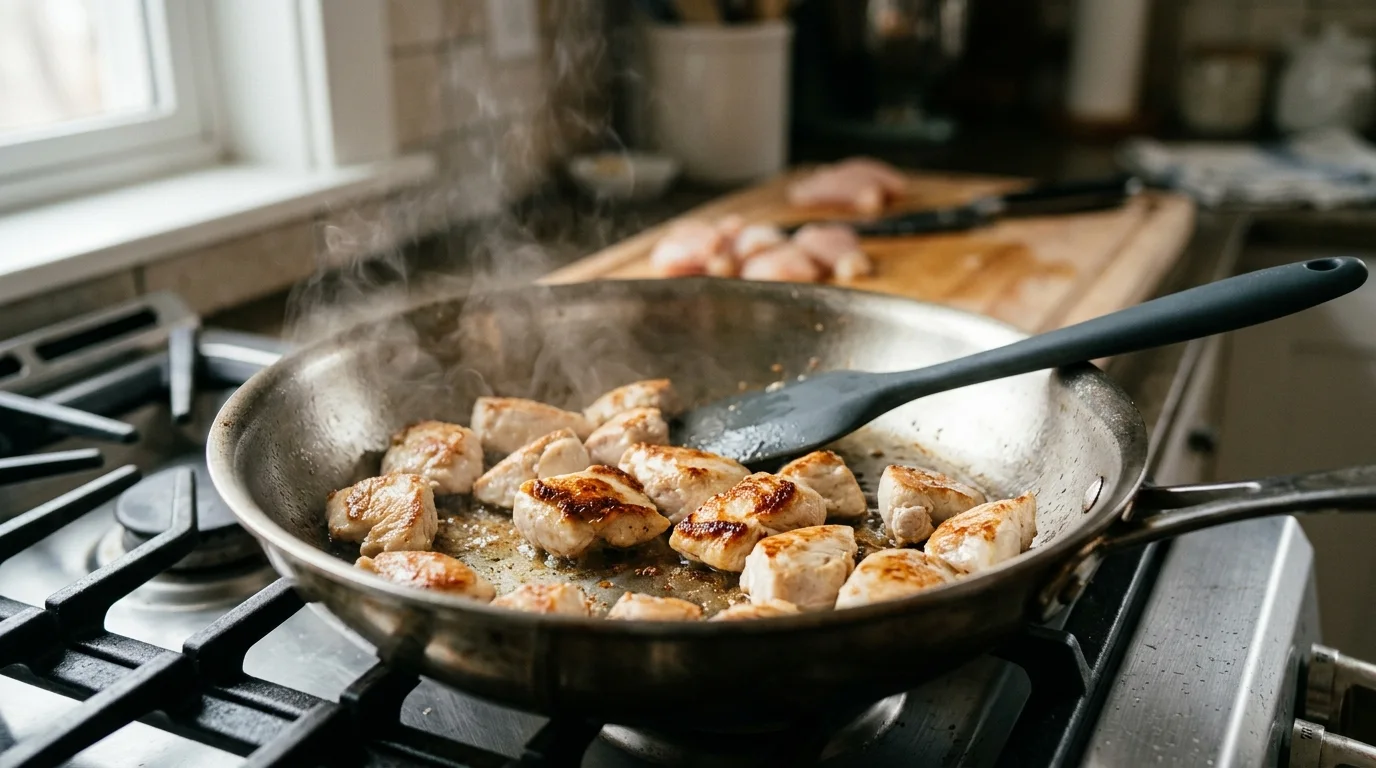
Raw breasts cooked in the skillet
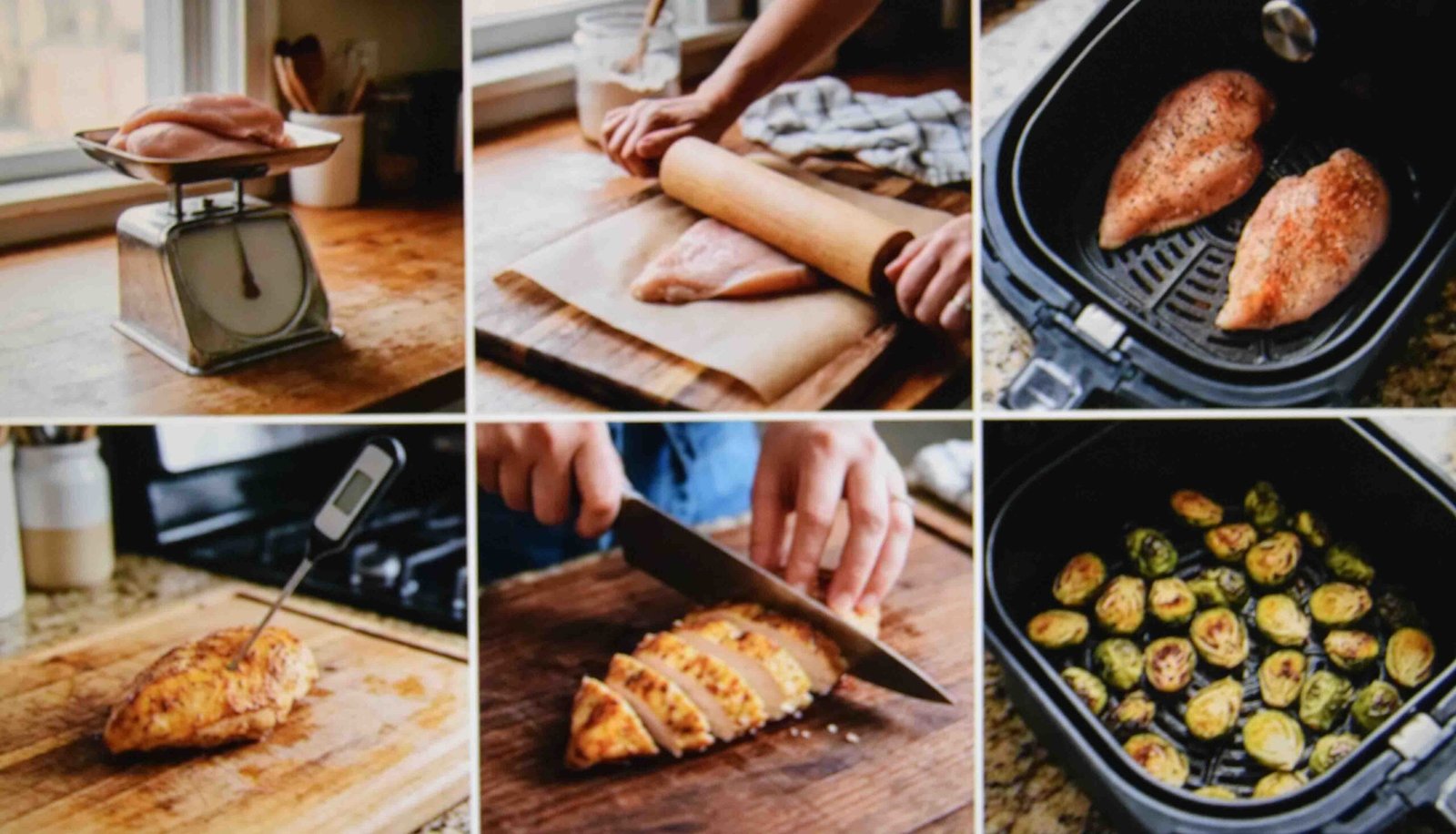
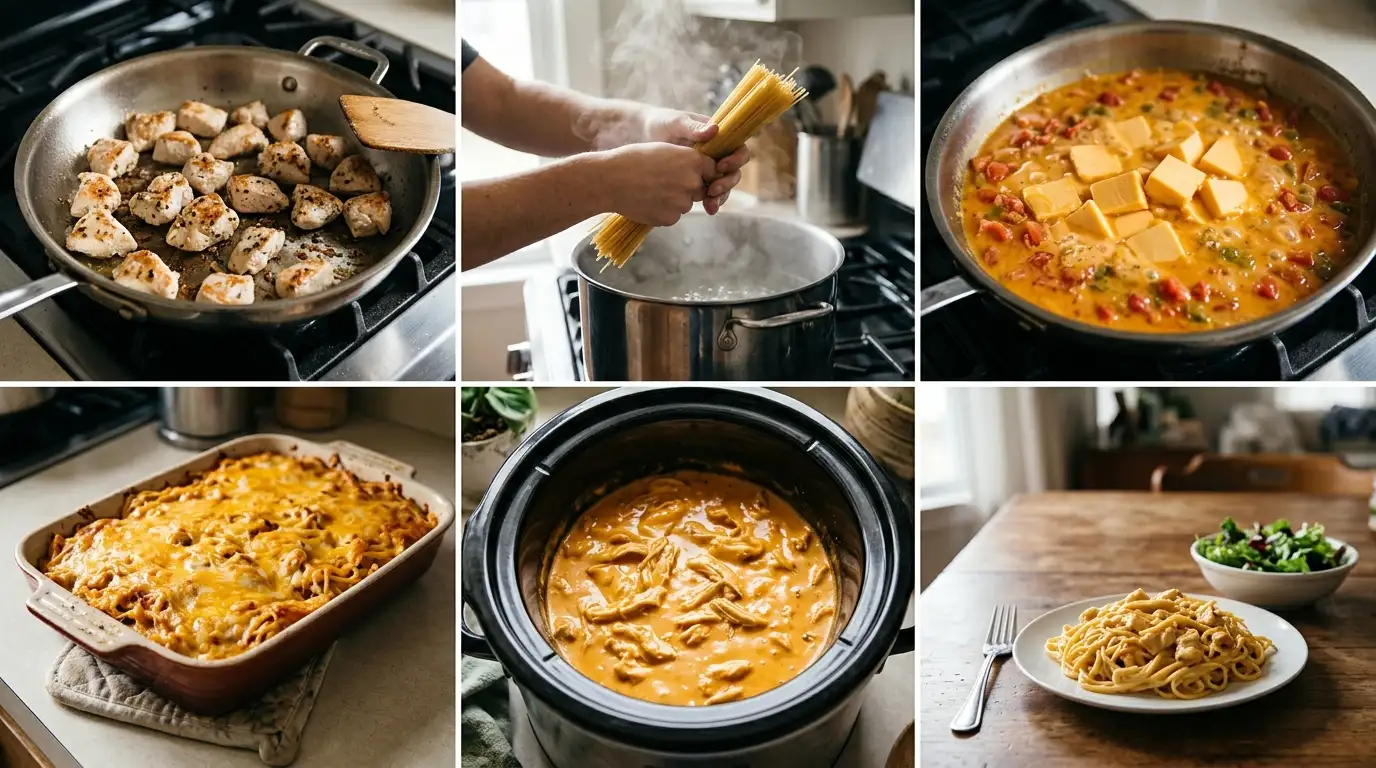
Chop a pound of boneless skinless breasts into ¾ inch pieces, small enough that one lands on your fork along with a tangle of noodles. Bigger chunks look nice, but they stay dry in the middle by the time the outside browns. Give the skillet a quick coat of cooking spray and keep the chicken moving over medium-high for 8 to 10 minutes. You’re after 165°F inside. No thermometer? Cut the biggest piece open, and if there’s no pink, it’s done.
The mistake to avoid is crowding everything into a narrow pan. The pieces steam instead of browning, and you lose the golden bits that flavor the sauce.
Rotisserie chicken on a rushed night
On a busy weeknight, this is the shortcut I’d take. One store-bought bird shreds into roughly 3 cups of meat, which covers the pound of breasts and lets you skip the skillet altogether. Pull it apart with two forks while it’s still slightly warm, since it shreds far more easily than chicken straight from the fridge. Leave the skin out. It turns rubbery once it sits in sauce.
One catch: flavored birds, like lemon pepper or barbecue, clash with the cheese, so grab a plain roasted one.
Thighs work as well, just trim the fat first or it puddles on top in the oven.
Getting the spaghetti right
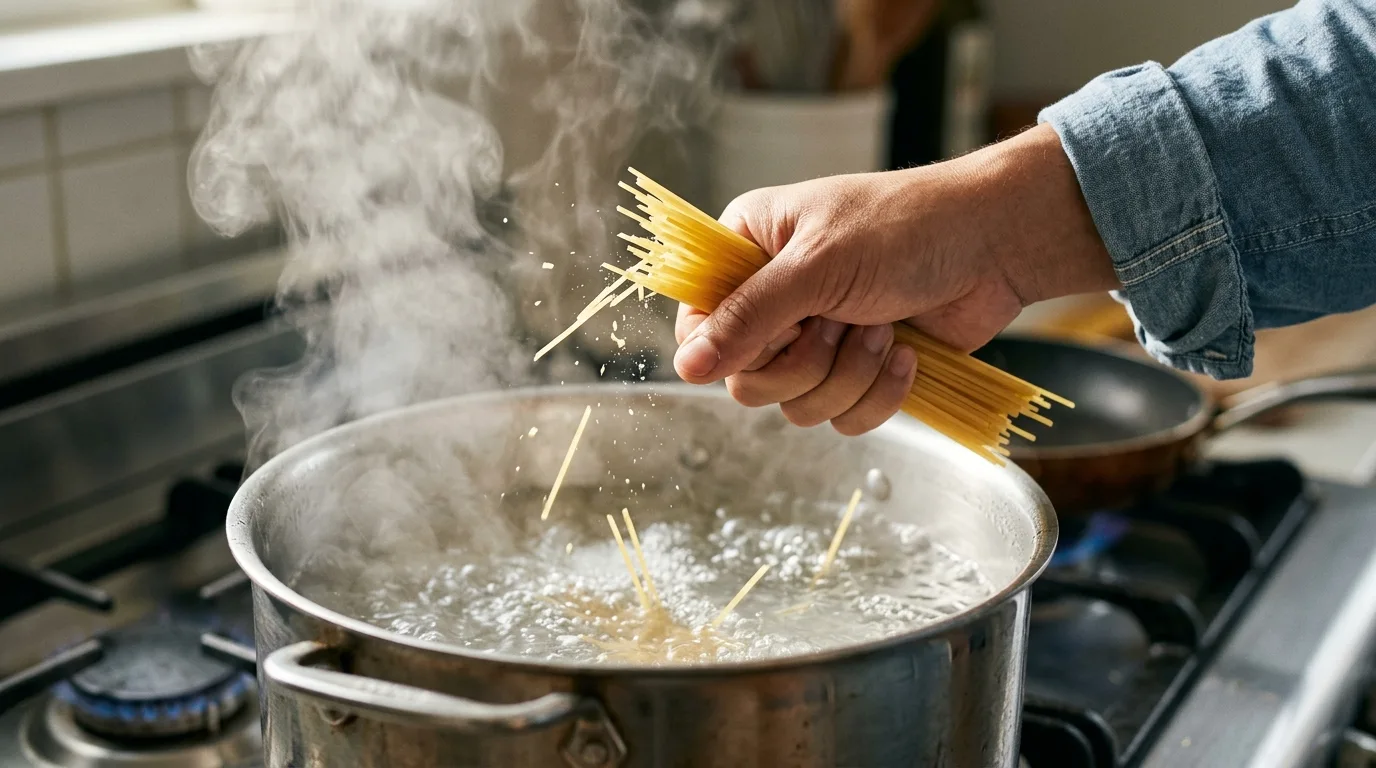
Break it before it hits the water
Hold the 12 ounces of spaghetti in a bundle over the pot and snap it into thirds, so each piece ends up roughly 3 inches long. Leave it full length and it twists into one giant nest in the dish, and serving it turns into a wrestling match with the spoon. Wrap a kitchen towel around the bundle before you snap if you don’t want shards flying across the stove.
A common slip is breaking it too short. Tiny bits overcook fast, and the finished dish starts to look more like soup than a casserole. Thirds is the sweet spot.
Pull it two minutes early
Check the box for the cooking time and subtract 2 minutes. If the package says 10, set a timer for 8. Fish out a strand when it goes off and bite it. You should see a thin white core in the center, and that’s exactly right, because the noodles finish cooking in the sauce later.
Fully cooked noodles go in soft and come out mushy, and no sauce, this one or a chicken spaghetti with velveeta allrecipes version, can fix that.
Thin spaghetti is the exception. It cooks so fast that pulling it 1 minute early is plenty.
Save a mug of the water
Right before you drain, dip a mug into the pot and keep ½ cup of the cloudy cooking water. That starch loosens the sauce later and helps it cling to the noodles better than milk would. Set the mug somewhere you’ll see it.
The usual mistake is tipping everything into the colander out of habit, then finding the sauce too tight with nothing good to thin it. Plain tap water is a weak substitute, because it dilutes the cheese without any starch to hold it together.
Leave the oil out of the pasta pot, too. It slicks the noodles, and then the cheese has nothing to grab.
Melting the Velveeta sauce
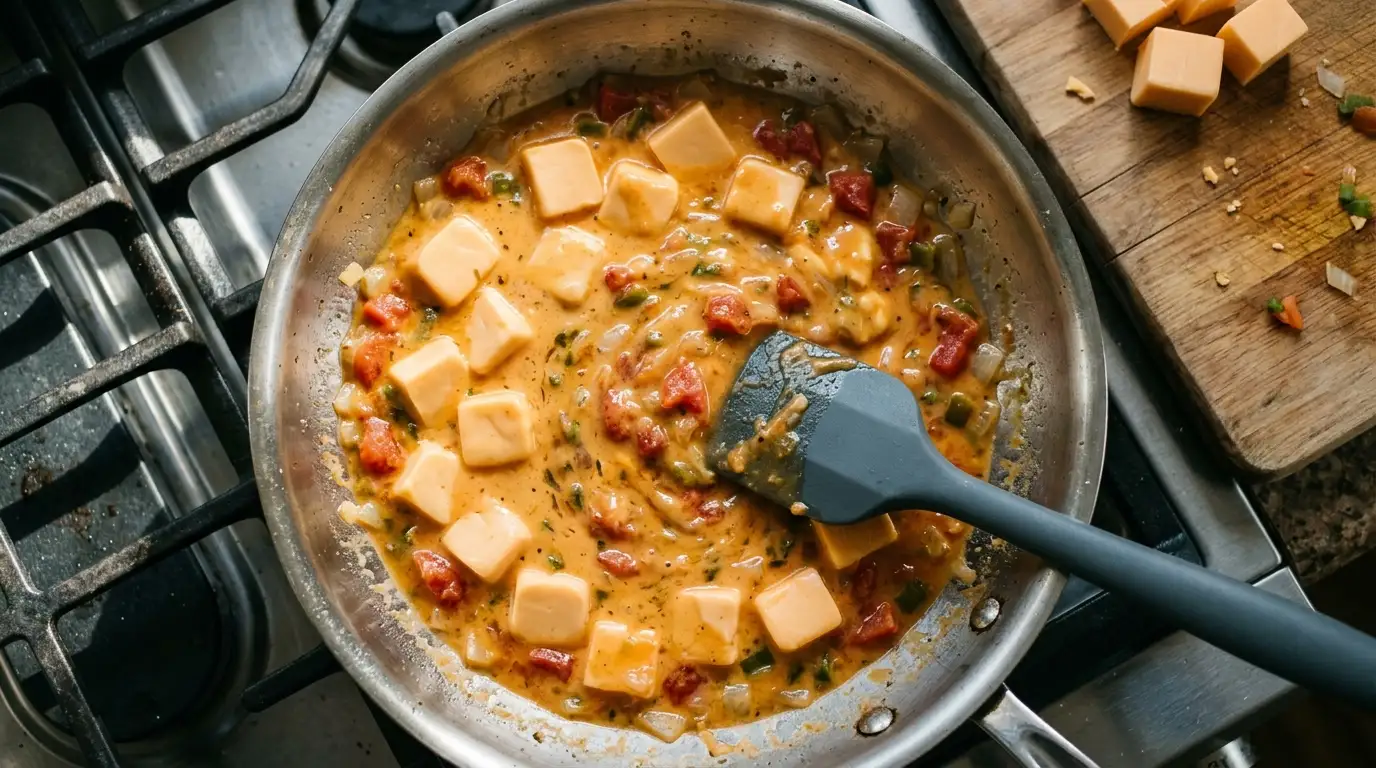
Cut the block into cubes
Twelve ounces is ⅜ of a 32 ounce block, which sounds fiddly until you cut the block into 8 even slabs and use 3 of them. Each slab weighs 4 ounces. Working with the 16 ounce block instead? Cut it into 4 slabs and use 3.
Dice those slabs into ½ inch cubes. Anything chunkier won’t finish melting during the short stir, and you’ll find pale lumps hiding in the casserole after baking.
Velveeta is soft and grabs onto the knife, so run the blade under hot water first, or keep the block chilled until the moment you cut it.
Stir everything together in one pan
Wipe out the chicken skillet with a paper towel, then soften the onion and green pepper over medium for 3 to 4 minutes, until the onion turns translucent. Turn the heat down to medium-low.
In go the soup, the tomatoes and chiles with their juice, the garlic powder, the pepper and the cheese cubes. Stir slowly and steadily for about 5 minutes, until no lumps remain and the color looks even all the way through.
Don’t crank the heat to hurry it along. Processed cheese catches on the bottom of the pan quickly, and scorched flecks spread through the whole sauce once they form.
Why it stays smooth
Velveeta has emulsifying salts built in, which keep its fat and protein bound together as it melts. That’s why velveeta recipes with chicken, like a party queso, can sit on a warmer without separating into a greasy layer.
To check the sauce, lift the spatula. It should run off in an unbroken ribbon within a couple of seconds, not drop off in clumps.
There’s still a limit. Let it bubble hard for too long and it thickens into a paste that’s tough to stir into the pasta, so a gentle simmer is as far as it should go.
Grab a silicone spatula and keep sweeping the corners as you stir, because that’s where cheese sticks first.
Swapping the soup and the heat
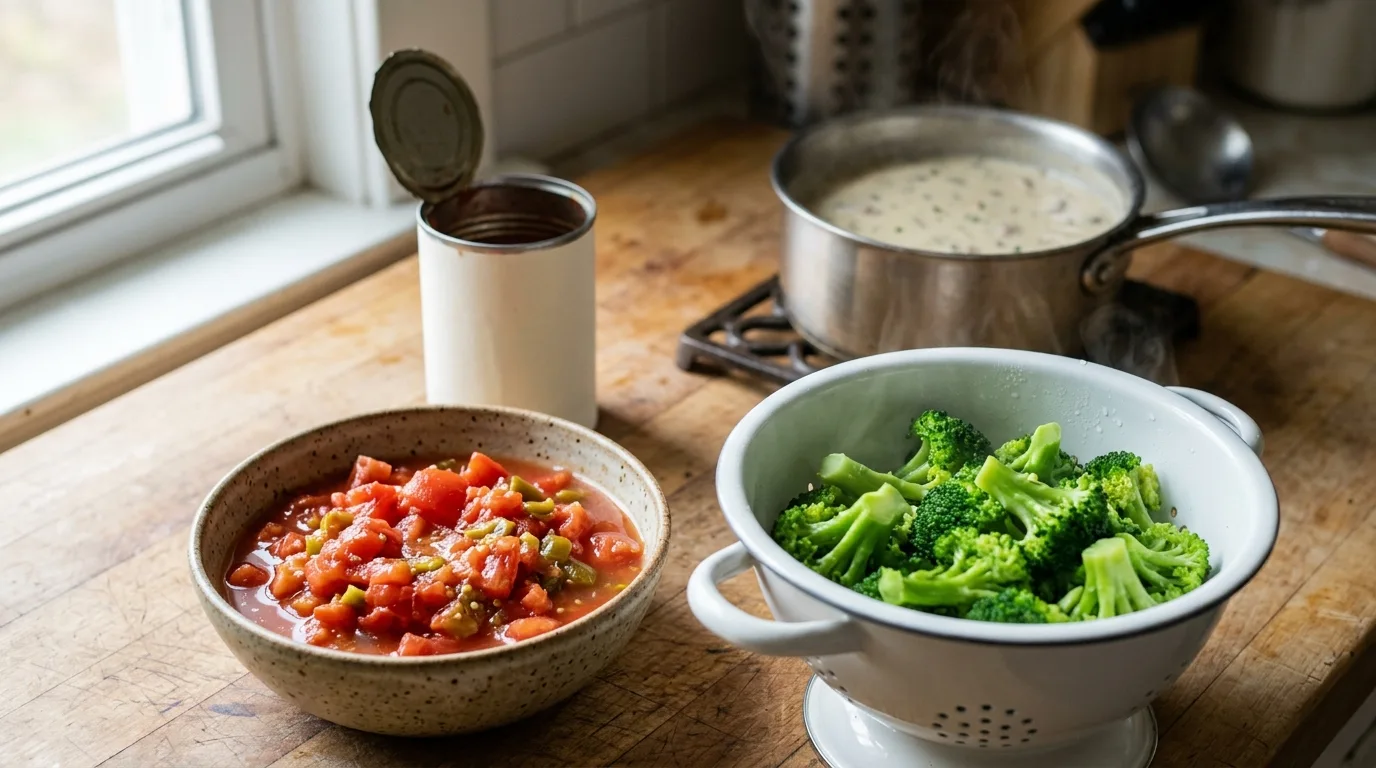
Cream of mushroom in place of chicken
Swapping in mushroom soup gives you a chicken spaghetti recipe with velveeta and cream of mushroom, and it’s a straight can-for-can trade, 10.5 ounces for 10.5 ounces. The flavor turns earthier. Not a mushroom family? Cream of celery works the same way.
Don’t add water to the soup the way the label suggests. It goes in undiluted, or the sauce bakes up thin.
Skip the flavored versions with roasted garlic or herbs, too, since they can drown out the cheese. And condensed soups usually contain wheat and dairy, so read the label before serving anyone with an allergy.
The can of tomatoes and chiles
Original Rotel has a noticeable kick. For a chicken spaghetti recipe with velveeta and rotel that kids will eat, buy the Mild can instead. It’s the same 10 ounce size, so nothing else in the recipe changes.
Pour it in with all its juice. Draining it is the easy mistake to make, and without that liquid the casserole bakes up dry around the edges.
Store-brand diced tomatoes with green chiles work just as well. The swap that falls flat is plain diced tomatoes, because you lose the chile flavor that gives this dish its personality.
A handful of broccoli
Want something green in the dish itself? Steam 2 cups of broccoli florets for about 3 minutes, until they’re bright green but still firm, then chop them bite size and stir them in right before the casserole goes into the oven. Pat them dry first. Wet broccoli leaks water while it bakes and thins the sauce.
Raw florets are a mistake here, since the bake isn’t long enough to soften them inside a dense casserole. Frozen broccoli works if you thaw it and squeeze out the liquid.
Hold off on the ¼ teaspoon salt until you’ve tasted the sauce, because the soup, cheese and chiles may have covered it already.
Putting it together and baking it
Mix in the pasta pot
Dump the drained spaghetti back into its pot, add the chicken and sauce, and toss with tongs for about a minute until every strand is coated. Mixing in the pot instead of the baking dish keeps sauce off the dish walls and coats everything evenly.
Then add the saved pasta water a splash at a time, ¼ cup first and more only if needed. You want it looser than you’d eat it, because the oven tightens it up.
The mistake is stopping when it looks right on the stove. That version comes out dry. If you’ve used the whole ½ cup and it still looks stiff, a splash of milk works in a pinch.
Bake time and doneness
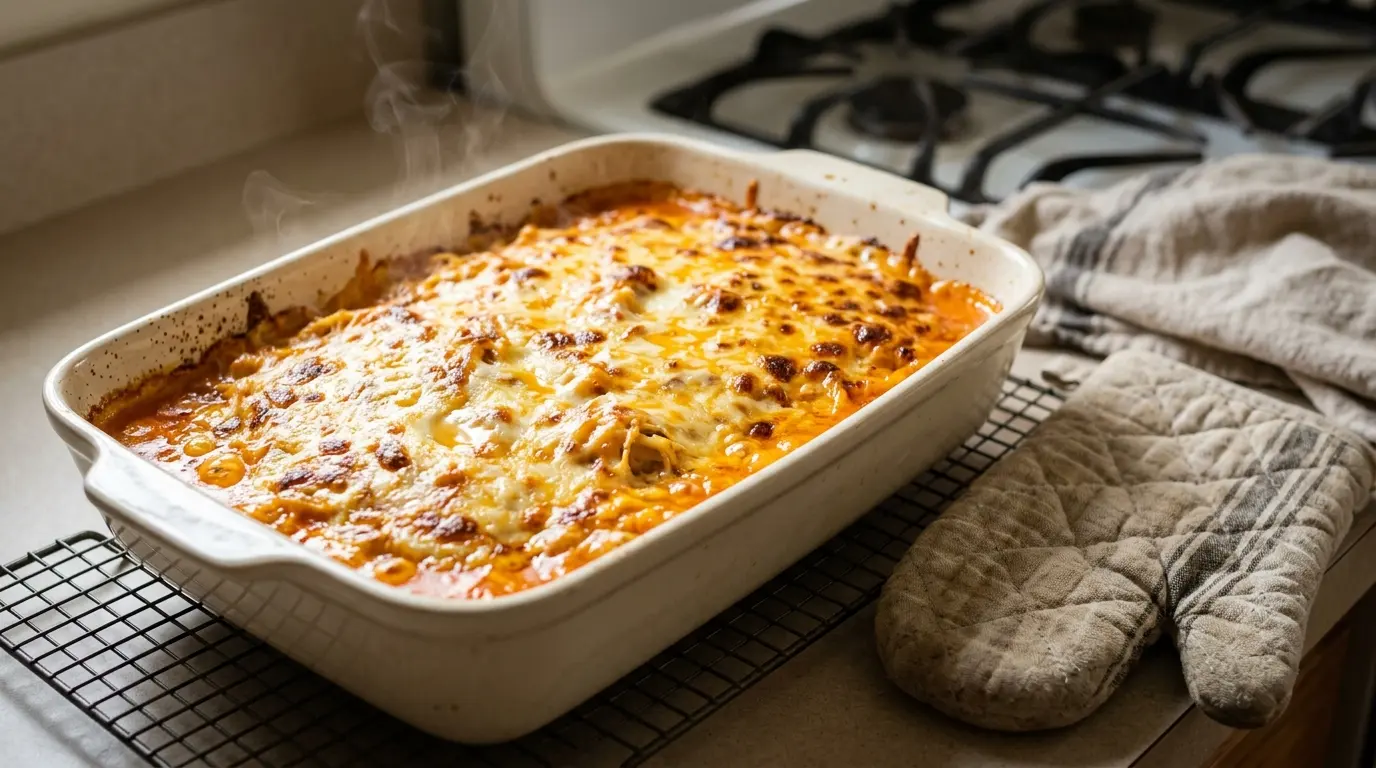
Spray the 13×9 dish, pour everything in, and spread it level so the corners aren’t thinner than the middle. Bake uncovered at 350°F for 30 to 35 minutes, until the edges bubble and it’s hot all the way through. The middle should read 165°F.
No thermometer? Slide a butter knife into the center, count to five, and carefully touch the blade. Hot means done. Lukewarm means a few more minutes.
Glass and ceramic dishes heat more slowly than metal, so lean toward the full 35 minutes in those. Foil is only worth using if the edges brown before the center is hot.
Cheese on top
Sprinkle ½ cup shredded cheddar over the dish once it has baked about 25 minutes, then let it finish. That’s how you get a cheesy chicken spaghetti recipe with velveeta that has a browned top. Added at the start, the cheddar sits in the oven too long and goes hard and greasy.
Want it darker? Switch to the broiler for 1 to 2 minutes at the end and stay by the oven door, because cheese goes from golden to burnt fast under a broiler. Skip this with glass dishes unless the label says they’re broiler safe.
Give it a short rest on the counter before scooping, or it runs all over the plate.
Making it in a slow cooker
What goes into the crock
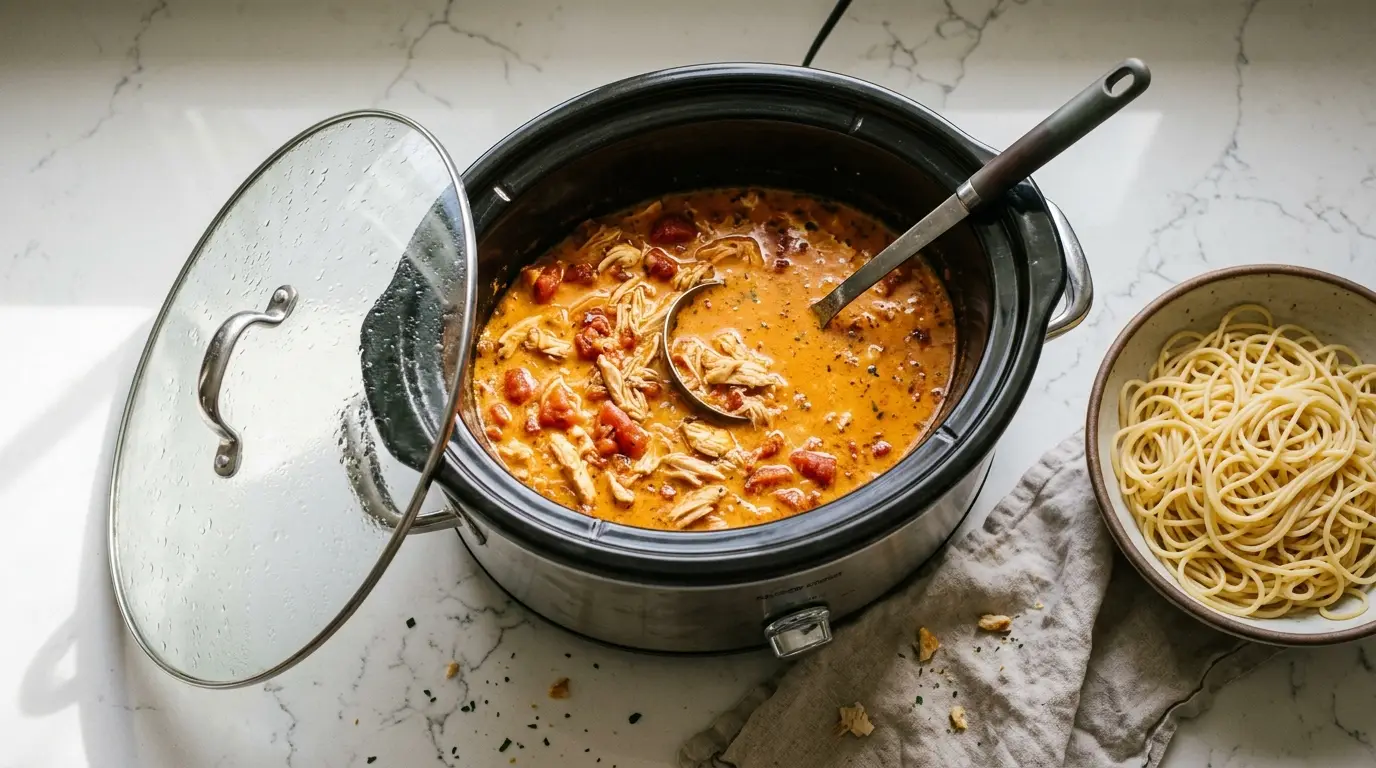
Use a 6 quart slow cooker for a chicken spaghetti recipe with velveeta crockpot recipe version. The raw chicken pieces go on the bottom, where the heat is steadiest, with the onion and pepper scattered over them. Spoon the soup and undrained tomatoes on top.
Skip browning the chicken. It can’t hold a crust in moist heat anyway.
Cook on low for about 4 hours, until the chicken reaches 165°F, and don’t lift the lid to peek, since every look lets heat escape and stretches the time. Add the cubed Velveeta for the final 30 minutes and stir once it softens. A 4 quart cooker gets crowded once the pasta goes in.
When the spaghetti joins in
Boil the pasta all the way to al dente on the stove this time, right at the package time, since there’s no oven bake to finish it. Drain it and stir it into the crock just before serving.
Dumping raw spaghetti straight into the slow cooker is the mistake to avoid. It cooks unevenly and goes gummy wherever it touches the sides.
Fair warning: you also lose the browned edges, and it eats more like saucy pasta than a proper casserole.
Switch to warm the moment the noodles go in. Another hour on low and they turn soft, so this version doesn’t hold up well for a long party.
Making it without Velveeta
What replaces it
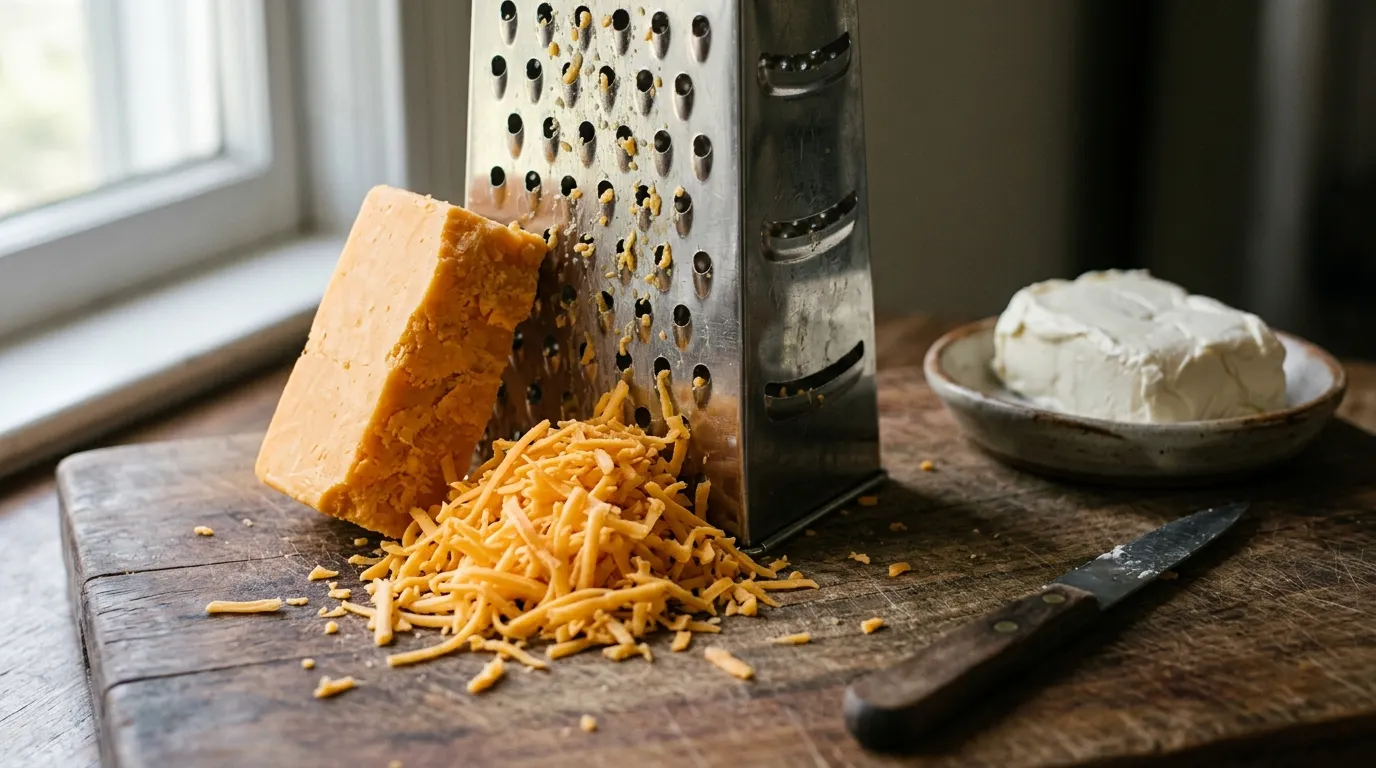
Chicken spaghetti without velveeta works with 2 cups of shredded sharp cheddar plus 4 ounces of cream cheese. Melt the cream cheese into the soup and tomatoes first, stirring until smooth, then add the cheddar a handful at a time.
Dumping all the cheddar in at once is the usual mistake. It clumps into one stringy mass that’s hard to break up.
The cream cheese brings back some of the smoothness Velveeta usually supplies. Really, at that point it’s a regular spaghetti with chicken recipe in cheddar sauce, which is no bad thing. Mild cheddar is too bland for this, though. Sharp carries the flavor.
Grate it from a block
Buy cheddar in an 8 ounce block and grate it yourself on the large holes of a box grater. That one block gives you about 2 cups, which is exactly what this version needs.
Pre-shredded bags are coated in anti-caking starch, and that coating keeps the shreds from melting together, which leaves the sauce gritty.
Grate it cold, straight from the fridge, because cheddar at room temperature smears on the grater instead of shredding cleanly. The only place bagged cheese is fine is sprinkled on top of the casserole, where a little grit won’t show.
Keep it off a boil
Melt natural cheese over the lowest heat your stove has, and pull the pan off the burner the moment the last shreds disappear. Let cheddar boil and its proteins tighten, the fat leaks out, and you’re left with clumps floating in oil.
If that happens, whisking in a tablespoon of pasta water hard can sometimes bring it back, but not always. Starting over is cheaper than serving a broken sauce.
Count on a tangier flavor and a sauce that firms up faster as it cools than the Velveeta version does, so serve this one straight out of the oven.
What to serve with it
Something green on the side
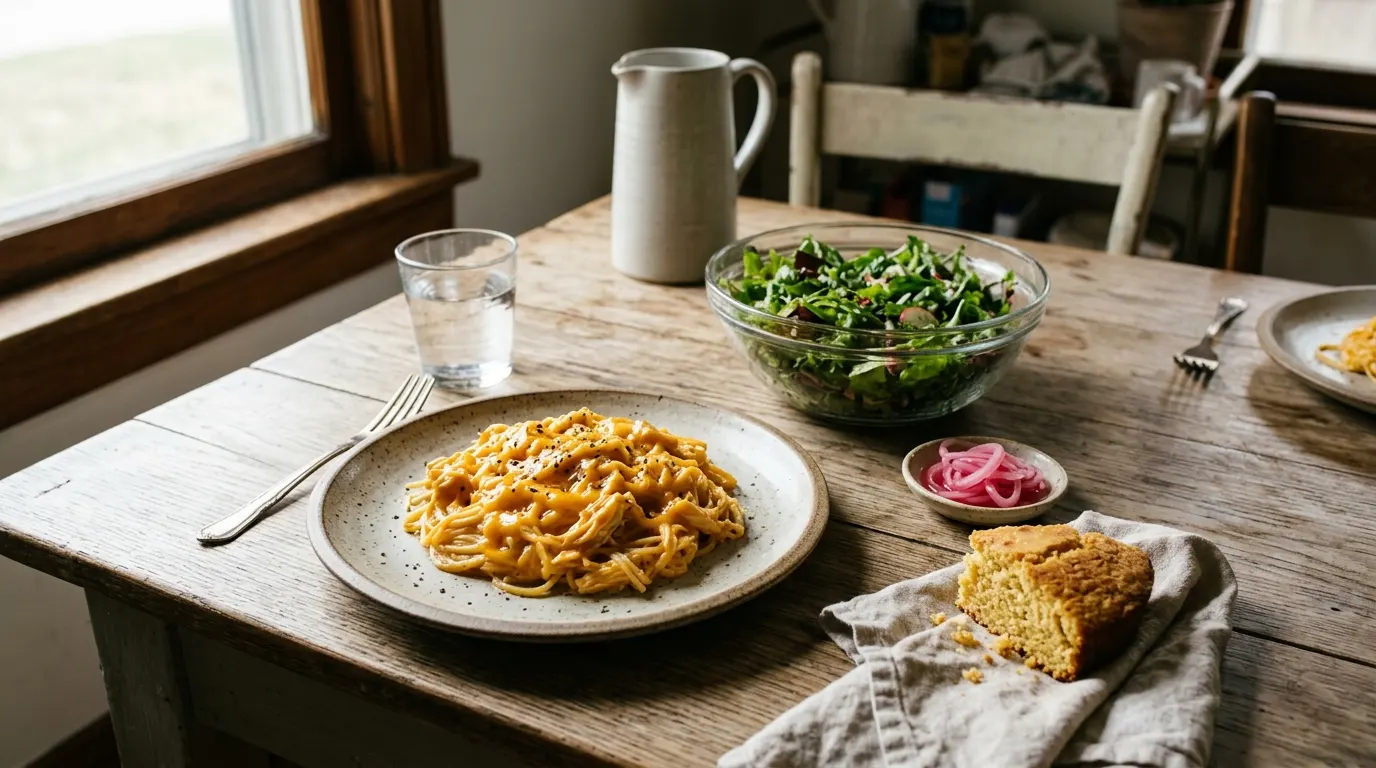
Toss a bagged salad with a vinegar-based dressing, about 2 tablespoons for every 4 cups of greens, and it cuts right through all that cheese. Creamy dressings like ranch are the mistake here. They pile more richness onto a dish that already has plenty.
Steamed green beans with a squeeze of lemon do the same job if salad is a hard sell at your table. Steam them for 5 to 6 minutes so they still snap.
Roasted broccoli is the side to skip if you already stirred broccoli into the casserole, since it just repeats itself on the plate.
Something tart
Quick pickled red onions beat plain lettuce here. Slice 1 red onion thin, cover it with ½ cup vinegar mixed with 1 teaspoon sugar and ½ teaspoon salt, and let it sit 20 minutes while the casserole bakes. A cucumber salad dressed in vinegar works the same way.
A sour bite between forkfuls keeps the richness from wearing you out halfway through the plate.
The mistake is reaching for sweet bread-and-butter pickles instead. Sugar doesn’t cut through cheese the way acid does. Quick pickled onions keep about a week in the fridge, so any extras won’t go to waste.
Bread, if anyone has room
Garlic bread is the usual pick, but this is already a carb-heavy dinner with 12 ounces of pasta in it. A plain dinner roll or a wedge of cornbread is plenty, one piece per person.
If you do go with garlic bread, slide it onto the rack above the casserole near the end of baking at the same 350°F, so both come out together.
Skip bread entirely for a lunch crowd or a kids’ table, where appetites run smaller.
Figure about 1½ cups per adult, so one 13×9 feeds eight.
How leftovers hold up over the following weeks
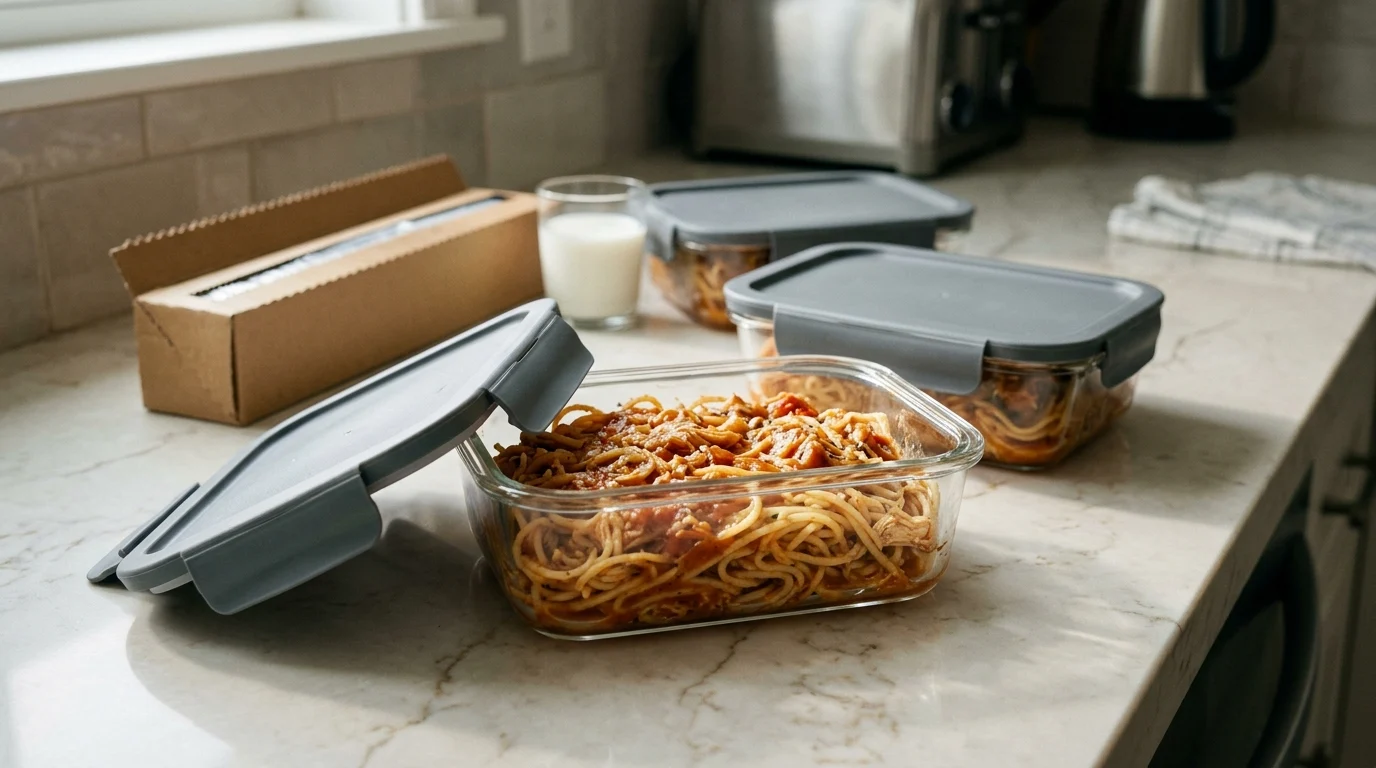
The first few days in the fridge
Cover leftovers and get them into the fridge within 2 hours of baking. They keep for up to 4 days, though by day two the noodles are noticeably stiffer.
Warm single portions in the microwave with about 1 tablespoon of milk per cup, stirring halfway through, until the center hits 165°F.
Reheating the whole cold 13×9 at once is the slow, uneven option, because the edges dry out long before the middle warms. If you have to, cover it with foil and drizzle a few splashes of milk across the top first. Anything left after day four goes in the trash, however it smells.
Several weeks in the freezer
Portion it into airtight containers and freeze for up to 3 months. A chicken spaghetti recipe made with velveeta cheese tends to freeze better than a cheddar one, because processed cheese is less likely to go grainy. Leave about ½ inch of headspace in each container, since the sauce expands as it freezes.
The pasta does come back a little softer. Thaw it overnight in the fridge, then bake covered at 350°F until it’s hot through. Microwaving it straight from frozen is the mistake, because the edges boil while the center stays icy.
Planning to freeze it from day one? Pull the spaghetti an extra minute early so it holds up to being reheated.
Quick answers about this chicken spaghetti recipe with Velveeta
Can I assemble it the night before?
Yep. Spread it in the sprayed dish, cover it tightly and refrigerate for up to 24 hours. Coming straight from the fridge, it needs extra oven time, so bake until the center reaches 165°F rather than going by the clock.
How do I make it spicier?
Swap in the Hot can of Rotel, or add a pinch of cayenne to the sauce. Pickled jalapeño slices scattered over the top after baking add heat only to the plates that want it.
Can I use a different pasta shape?
Penne, rotini and elbows all work, and their tubes and ridges hold more sauce than spaghetti. Skip angel hair. It falls apart into mush in the oven.
Feeding a bigger crowd with it
This chicken spaghetti recipe with Velveeta doubles cleanly for a potluck, as long as you bake it in two 13×9 dishes instead of one deep roasting pan. A deep pan bubbles at the edges long before the middle warms, so you end up drying out the outside just to get the center to 165°F. Two shallow dishes bake in the usual time if you put them on separate racks and swap them halfway. Mix each batch in its own pot as well, because 24 ounces of spaghetti won’t toss evenly in a standard pasta pot. For the drive over, cover each dish with foil and wrap it in a thick towel.