



Twenty to seven on a Wednesday. Four chicken breasts in the fridge, a hankering for steak au poivre, and ribeye at a price that makes you wince at the meat counter. Chicken au poivre fixes that. You keep the cracked pepper crust and the cream sauce, swap in a much cheaper protein, and eat in about 35 minutes.
What makes or breaks it is the pepper. It needs to toast, not burn, and it only gets the handful of minutes the chicken spends cooking. Nearly everything below is about buying it that window.
What you need
Prep time: 15 minutes
Cook time: 20 minutes
Total time: 35 minutes
Servings: 4
Ingredients
- 4 boneless skinless chicken breasts, 6 to 8 ounces each
- 1 teaspoon kosher salt
- 2 tablespoons whole black peppercorns
- 2 tablespoons neutral oil
- 2 tablespoons unsalted butter, divided, one tablespoon kept cold
- 1 large shallot, finely minced
- ⅓ cup low sodium chicken broth
- ¾ cup heavy cream
- 1 teaspoon Dijon mustard
- 1 tablespoon chopped fresh chives or parsley, optional
Equipment
- 12 inch stainless steel or cast iron skillet
- Flat meat mallet or a heavy saucepan
- Zip-top bag and rolling pin, or a mortar and pestle
- Fine mesh sieve
- Wire rack set over a sheet pan
- Instant read thermometer, optional
1. Boneless breasts pounded to an even ¾ inch
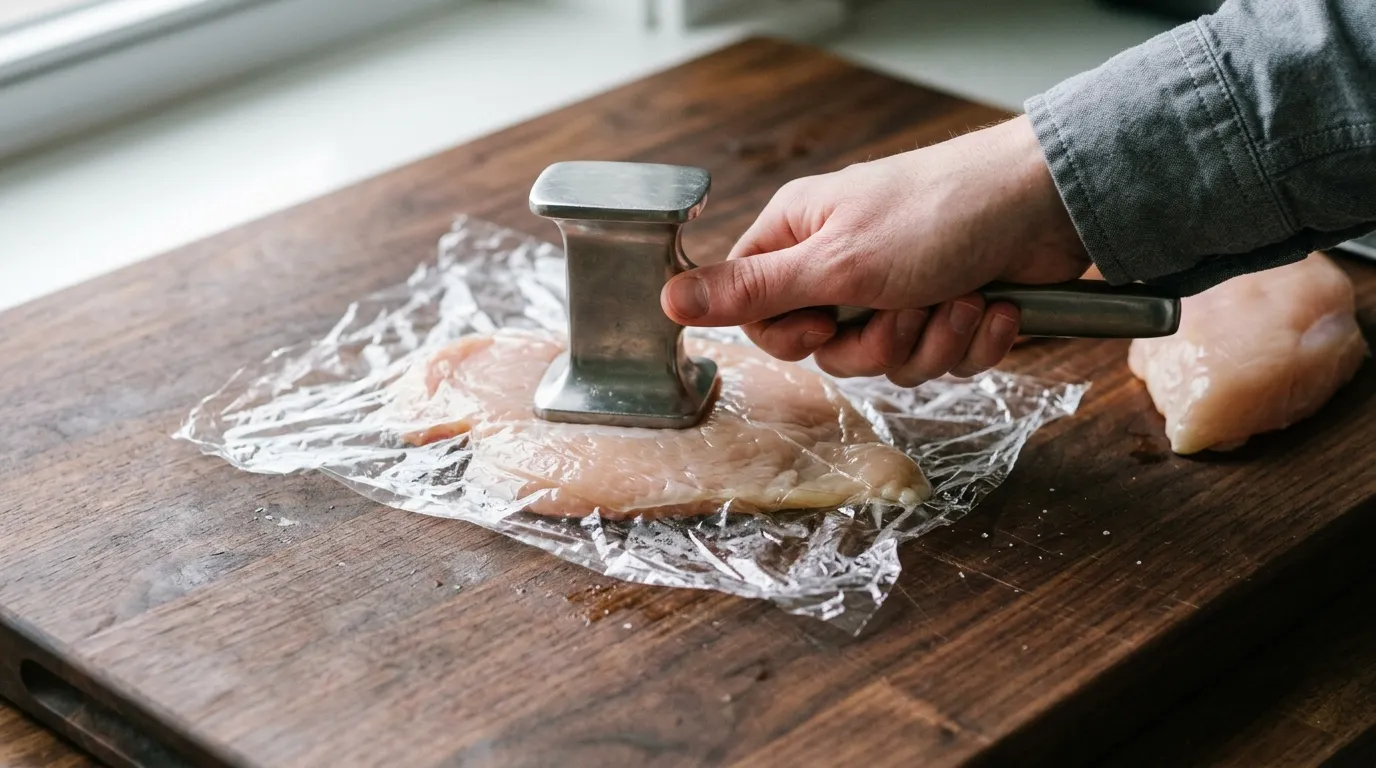
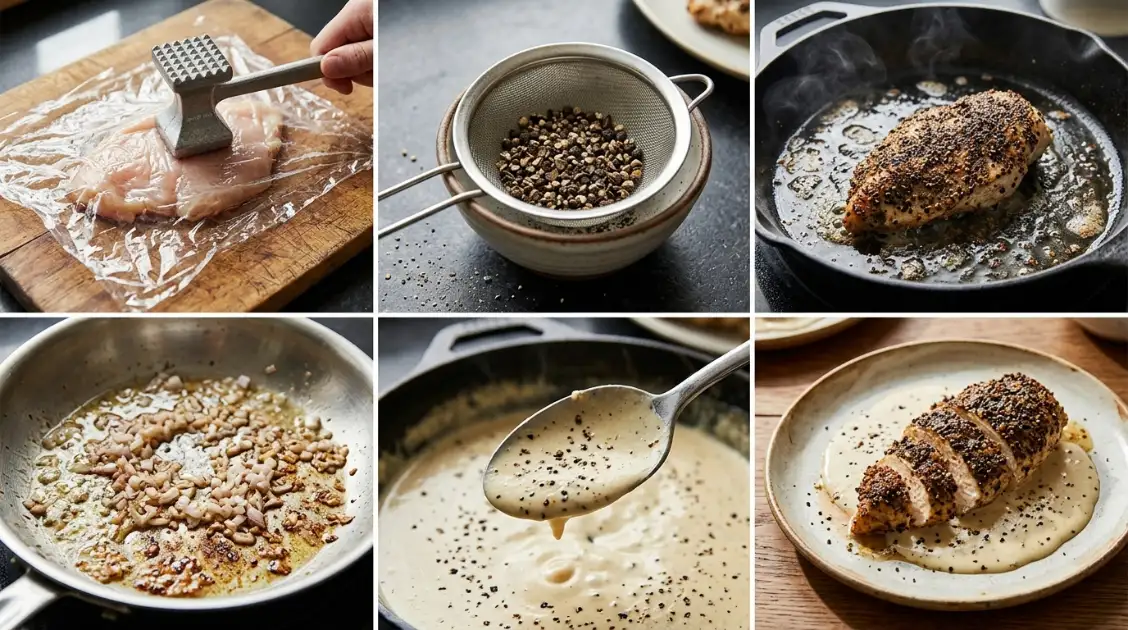
Lay a breast on plastic wrap, fold the wrap over the top, and get pounding with a flat mallet. No mallet? The bottom of a heavy saucepan does fine. Work from the center out, because coming down hard on the thin edge just shreds it.
Stop at about ¾ inch. Breasts come out of the package shaped like a teardrop, fat on one end and skinny on the other, and left that way the skinny end dries to cardboard while the fat end is still raw inside.
Blot both sides with paper towels after. Wet chicken and pepper don’t get along.
This chicken au poivre recipe leans on breasts mostly because that’s what sits in neat four-packs at every grocery store. Go this way if your crowd likes white meat that slices cleanly.
2. Boneless thighs for a version that’s hard to overcook
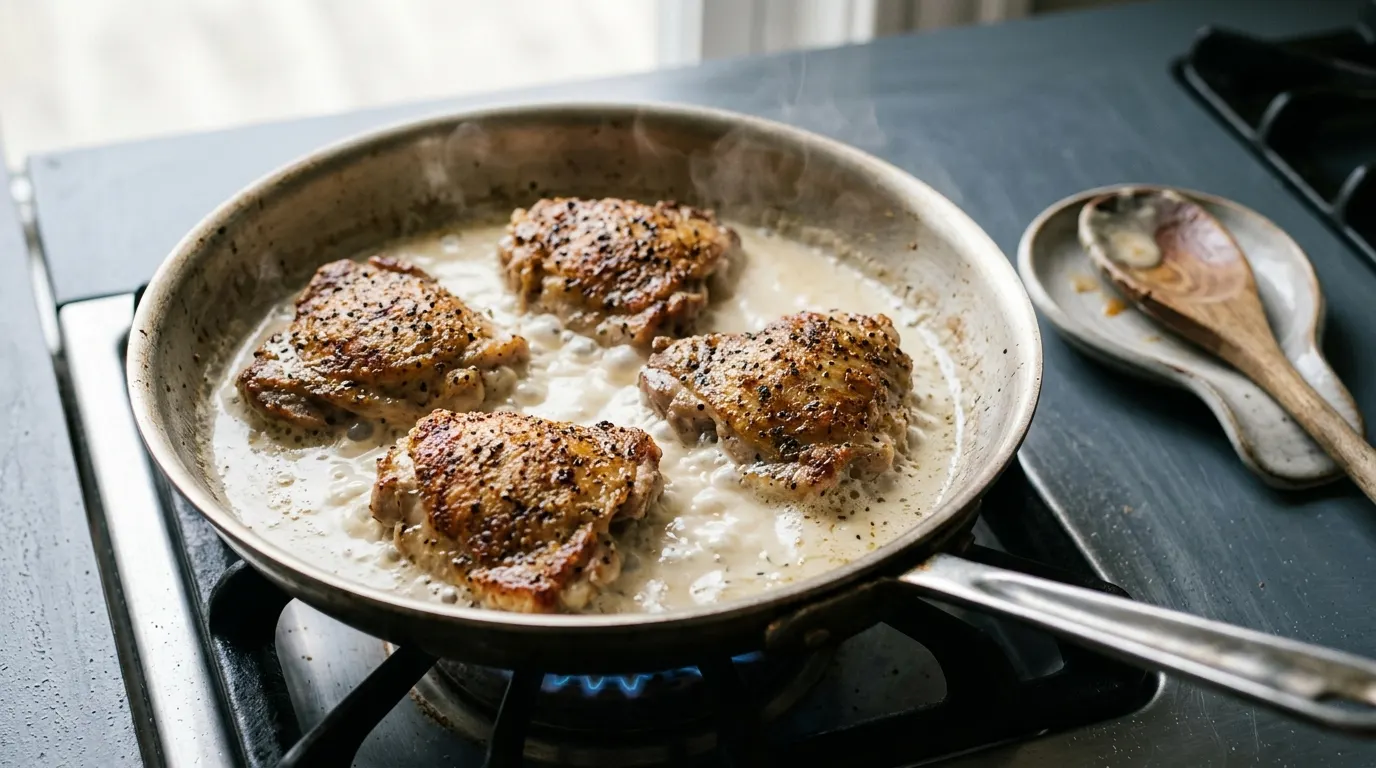
Honestly? Thighs are the safer bet for a first try. There’s more fat laced through them, so if you overshoot by a minute nobody ends up chewing rubber.
They take longer, though. For chicken au poivre with thighs, brown them in a single layer for 6 to 8 minutes per side, then let them finish in the cream sauce for another 6 to 8 while it thickens around them. Skip the mallet. Just snip away any big floppy pieces of fat.
Aim for 175°F rather than 165°F. Both are safe, but the extra heat melts the connective tissue, and that’s what turns a bouncy thigh into a tender one.
Count on 6 to 8 thighs for four people, depending on how big they run. Bonus: pound for pound they’re usually cheaper than boneless breasts.
3. Whole black peppercorns, crushed coarse
Forget the grinder for this one. Even on its coarsest notch it makes pepper too fine, and fine pepper goes acrid as soon as it hits the oil.
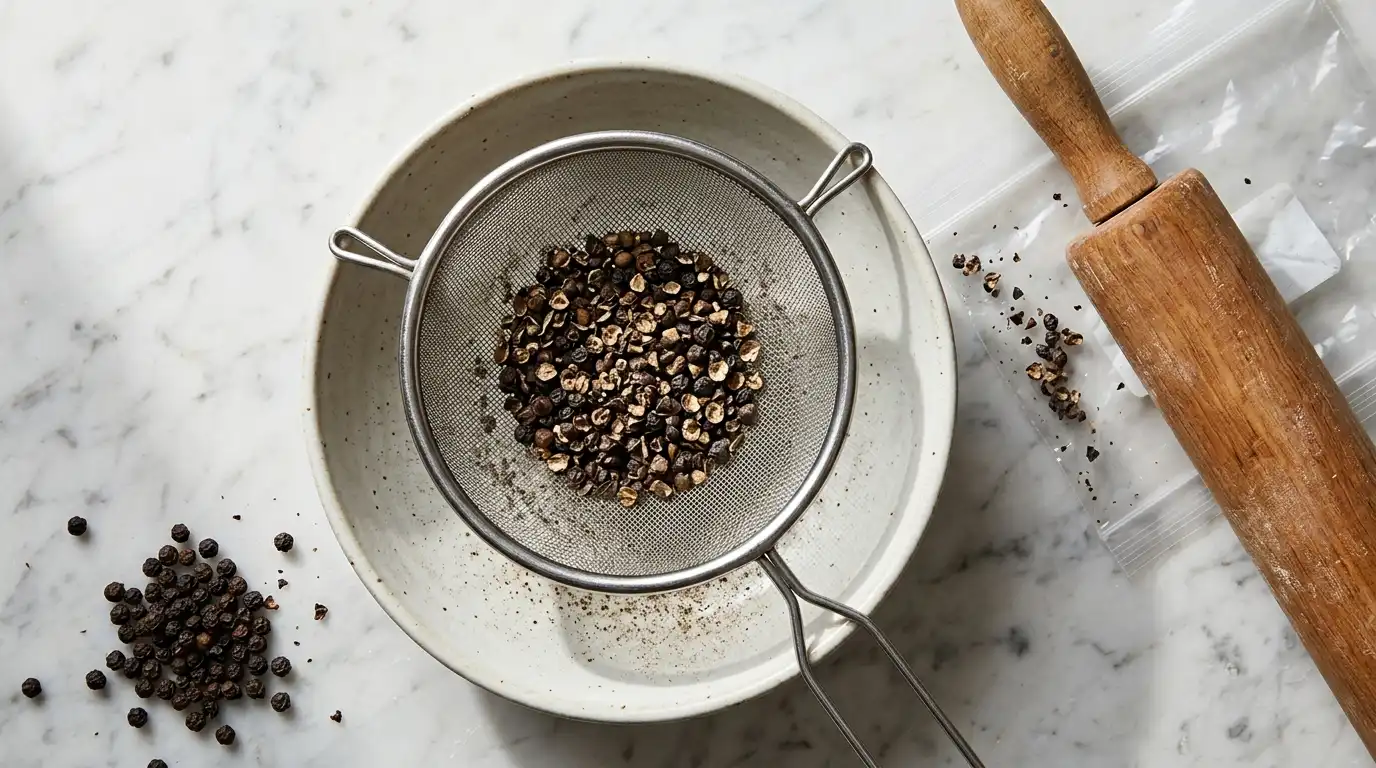
Pour 2 tablespoons whole peppercorns into a zip-top bag, press out the air, and roll over it with a rolling pin, leaning your weight in, until most of them crack into halves and quarters. Expect a few to ricochet off the counter. A mortar and pestle is the calmer option.
Now shake everything through a fine mesh sieve. What falls through is powder, and powder burns first, so save it for salad dressing. Whatever stays in the sieve is your crust.
Pre-ground pepper from a tin won’t cut it. It’s flat and dusty.
You can skip the sieve, but only if the cracking came out pretty even and there’s barely any powder in the bag.
4. A salt and pepper press, then a 10 minute rest
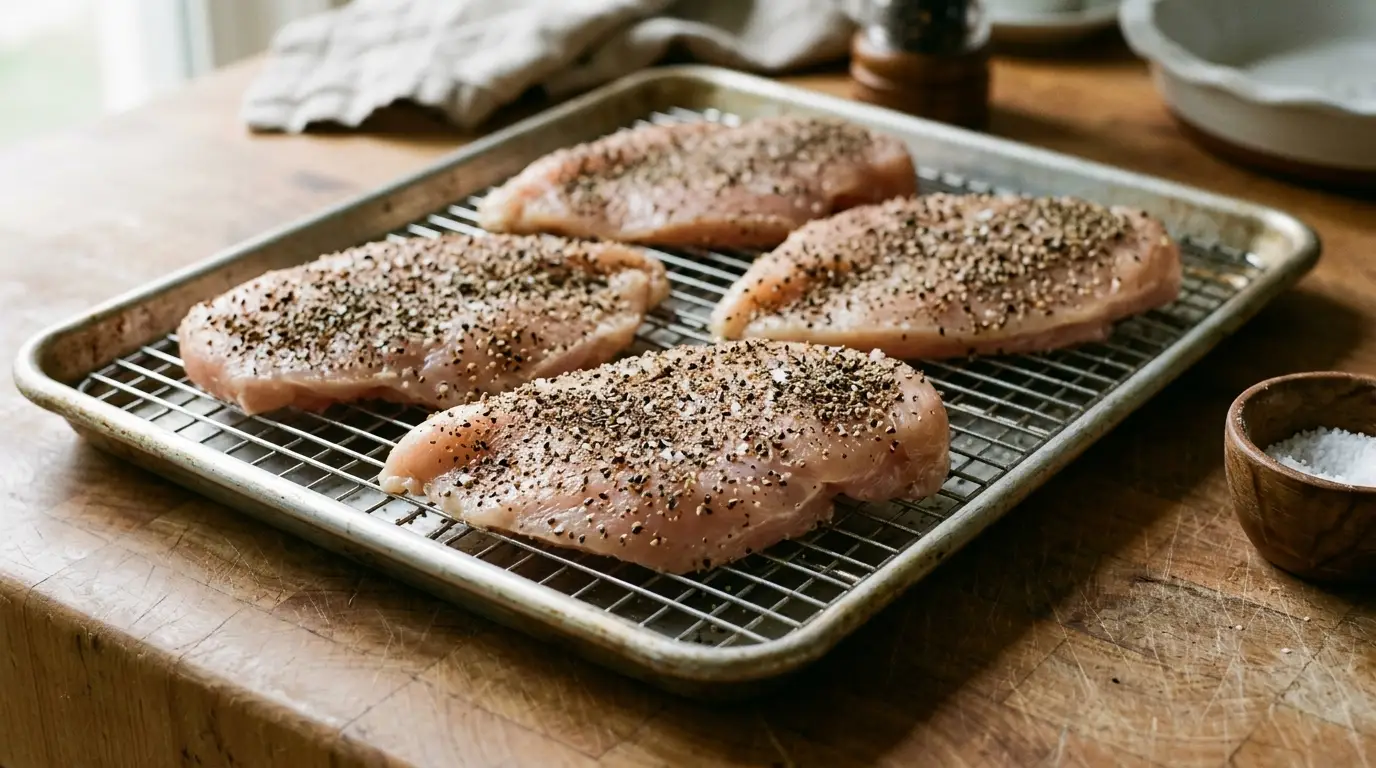
Salt first, roughly 1 teaspoon kosher salt over all four pieces. Pepper second, and only on the top side, pressed in firmly with the heel of your hand so it actually digs into the meat.
One side is deliberate. Doubling up means twice the chance of scorching and a noticeably spicier dinner. Plus, the crusted side goes into the pan first while the oil is fresh, and that’s when pepper toasts best.
Then leave it for 10 minutes. Salt pulls a little moisture to the surface, it goes tacky, and that tack is the glue. Cook it right away and you’ll be scraping half the crust off the skillet later.
Set the chicken on a wire rack over a sheet pan for that rest. With air underneath, the bottom stays dry instead of sitting in its own juice.
5. A 12 inch skillet over medium high heat
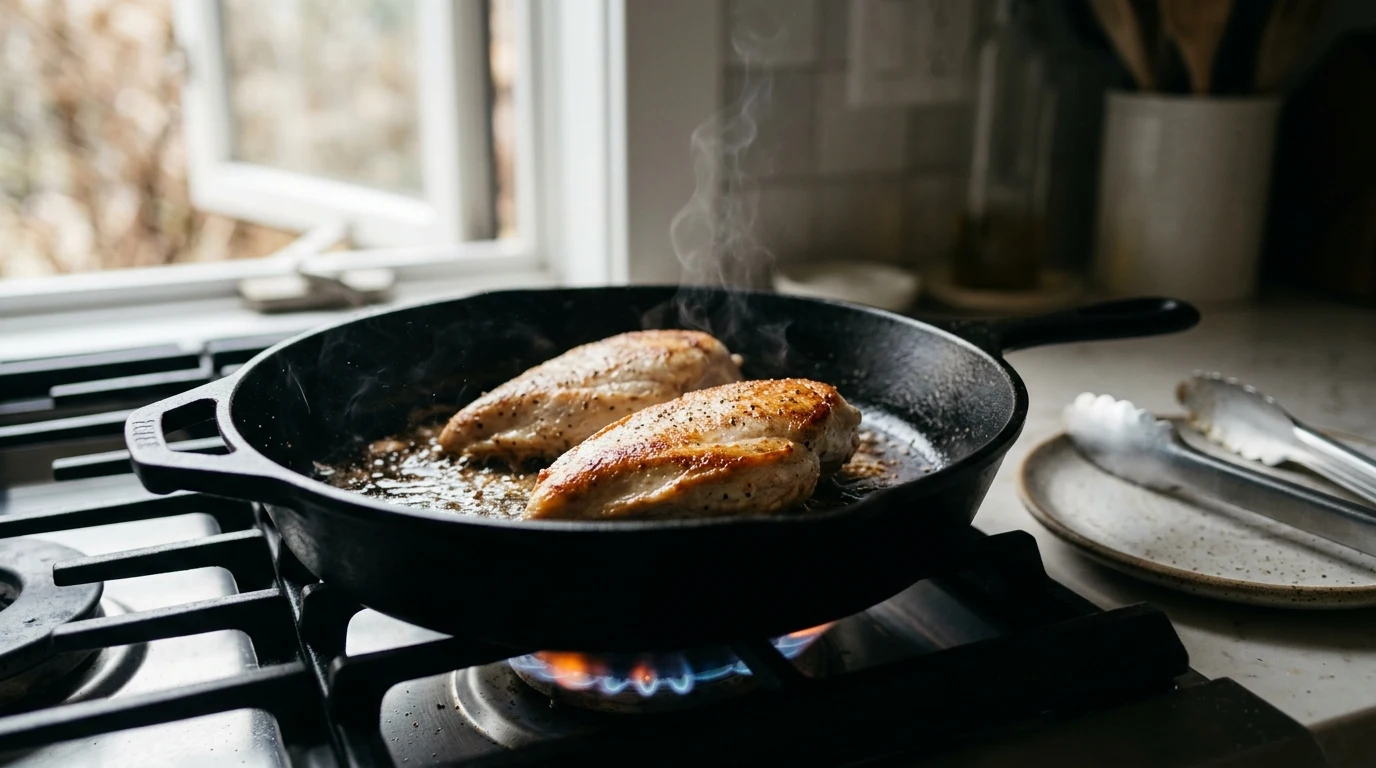
Put a 12 inch stainless or cast iron skillet over medium high and add 2 tablespoons neutral oil. Wait for the shimmer. Then lay the chicken in, pepper side down, and don’t fiddle with it.
Medium high, not high. And crack a window, because cracked pepper landing in hot oil sends up a throat-tickling vapor that sets off coughing fits.
Breasts need about 5 to 6 minutes on the crusted side and 4 to 5 on the flip side, until the thickest spot hits 165°F. No thermometer? Cut into the fattest piece. White all the way through, clear juice, zero pink in the center.
Move the chicken to a plate. Leave the pan right where it is.
Cast iron is the pan for anyone obsessed with a dark crust, since it hardly loses heat when the chicken lands.
6. One large shallot and the browned bits
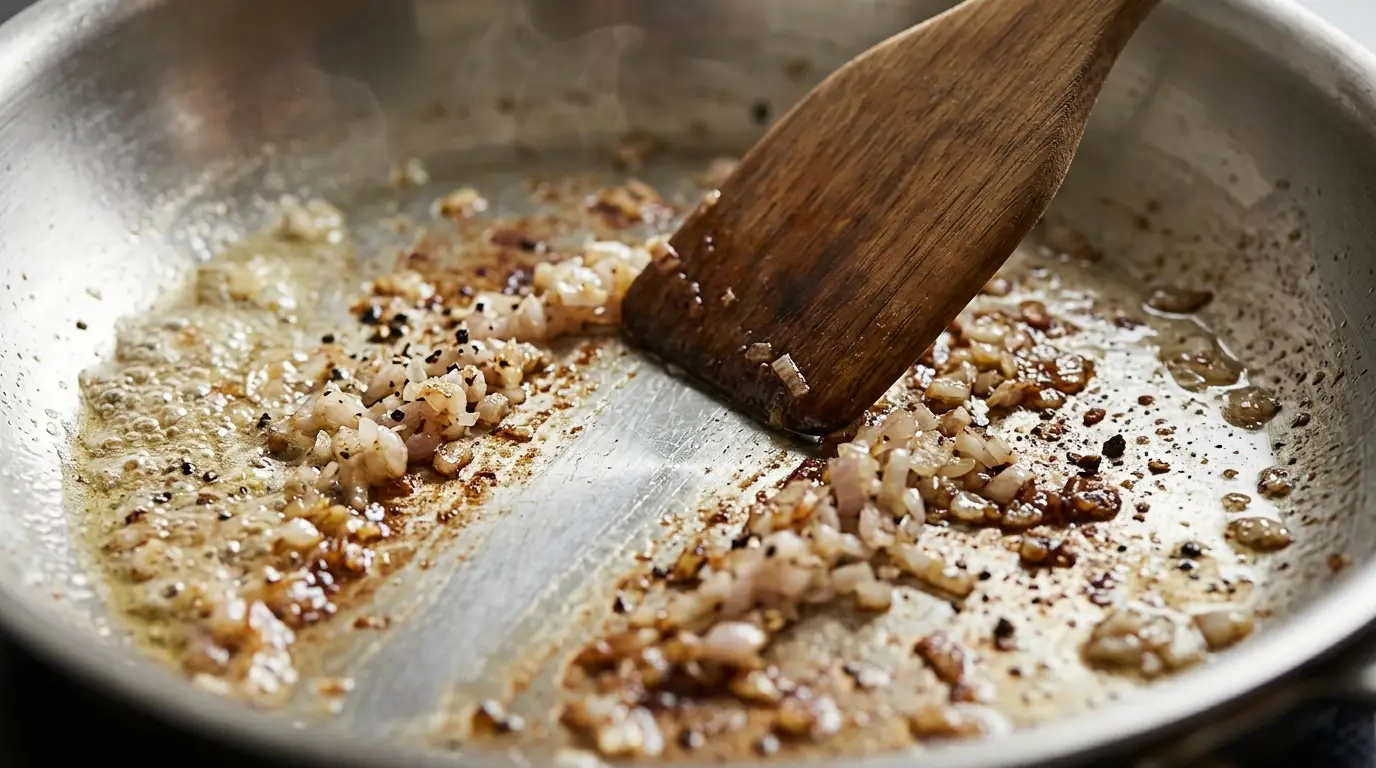
Pour off the fat until roughly a tablespoon remains, lower the heat to medium, and melt in 1 tablespoon butter. Add the shallot and stir for about 2 minutes, until it softens and goes see-through.
Scrape as you stir. The brown bits stuck to the pan, with a few stray peppercorns in the mix, are the backbone of the sauce. That’s also why nonstick pans make a weaker sauce. They leave nothing behind to scrape.
Mince it small. A sauce that only simmers a few minutes won’t soften big chunks.
Why not onion? Shallot is milder, a touch sweet, and melts down faster. One will do, or two little ones. Per pound they cost more than onions, but you’re buying a single one, so you won’t notice it on the receipt.
A quick buying note on cream and peppercorns
Heavy cream, also labeled heavy whipping cream, is what you want. Skip half-and-half. It has less fat and tends to break into grainy curds once it reduces with mustard. Light cream lands in between and isn’t worth the risk.
Tellicherry peppercorns cost slightly more than the standard jar, and they earn it. They ripen longer on the vine, grow bigger and smell fruitier, so the crust tastes like actual pepper rather than just heat. And if your jar of peppercorns has survived three apartments, its aroma is mostly gone.
There are versions out there tied to big names, chicken au poivre by kay chun, a chicken au poivre coco larkin recipe, a chicken au poivre ina garten recipe. Follow any of them and these two buys still decide how it tastes.
7. A splash of broth to lift the fond
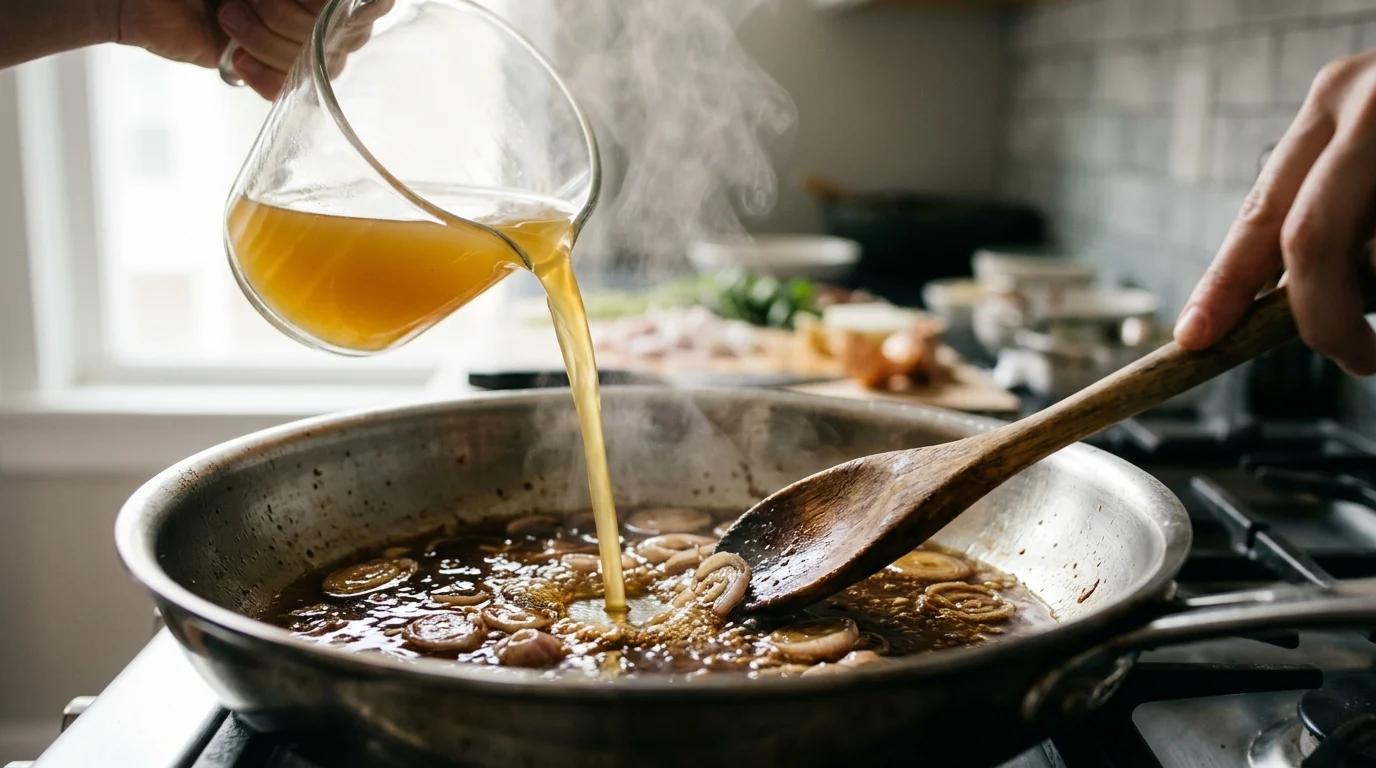
Add ⅓ cup low sodium chicken broth and scrape at the pan with a wooden spoon. Let it bubble over medium until it’s nearly gone, about 1 minute, leaving a couple of spoonfuls of syrupy liquid.
Only have regular broth? Drop the salt on the chicken to ¾ teaspoon, because full sodium broth reduces down into something surprisingly salty.
Bistros often use cognac at this stage and sometimes set it alight. Broth is used here because it’s easier and keeps open flames away from your kitchen towels. If you want cognac anyway, take the pan off the burner, measure it into a cup first, and never pour from the bottle near a flame.
And cooking doesn’t burn off every bit of alcohol, so skip the cognac when kids are at the table.
8. Heavy cream and Dijon, reduced until they coat a spoon
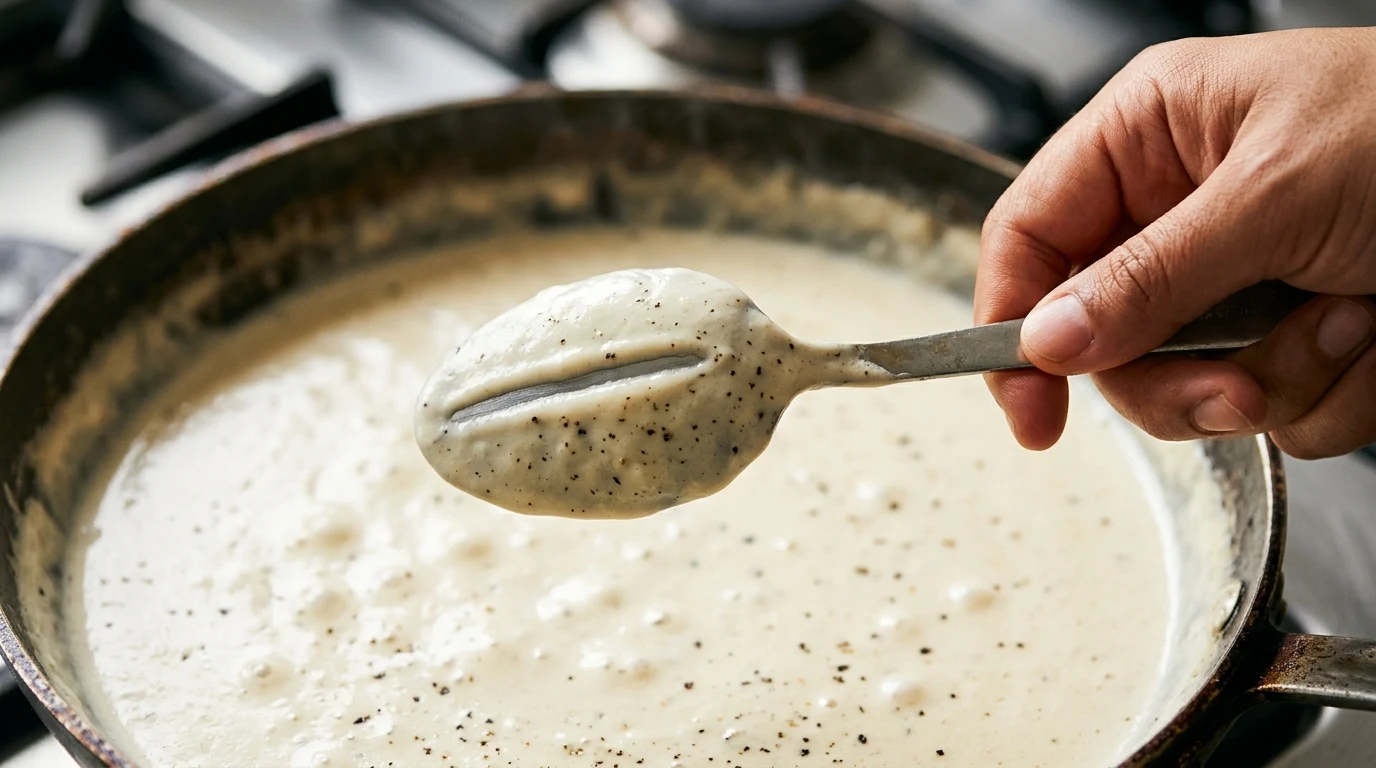
Pour in ¾ cup heavy cream with 1 teaspoon Dijon and stir until it all comes together with the shallots. Keep it at a gentle simmer, just bubbling at the edges, for 3 to 4 minutes.
Check it with a spoon. Dip, lift, run a finger across the back. If the line stays put, it’s ready. If the sauce runs back together, give it another minute.
It tastes mellow up front. A few bites in, the pepper starts creeping up on you, and the mustard keeps all that cream from going dull. A good chicken au poivre creamy peppercorn sauce should taste like pepper before it tastes like dairy.
Leave out the Dijon for anyone allergic to mustard. Dairy is baked into this sauce, though, so it won’t work for guests who avoid it.
Set out crusty bread. Somebody always wants to mop up what’s left on the plate.
9. Cold butter and the resting juices, off the heat
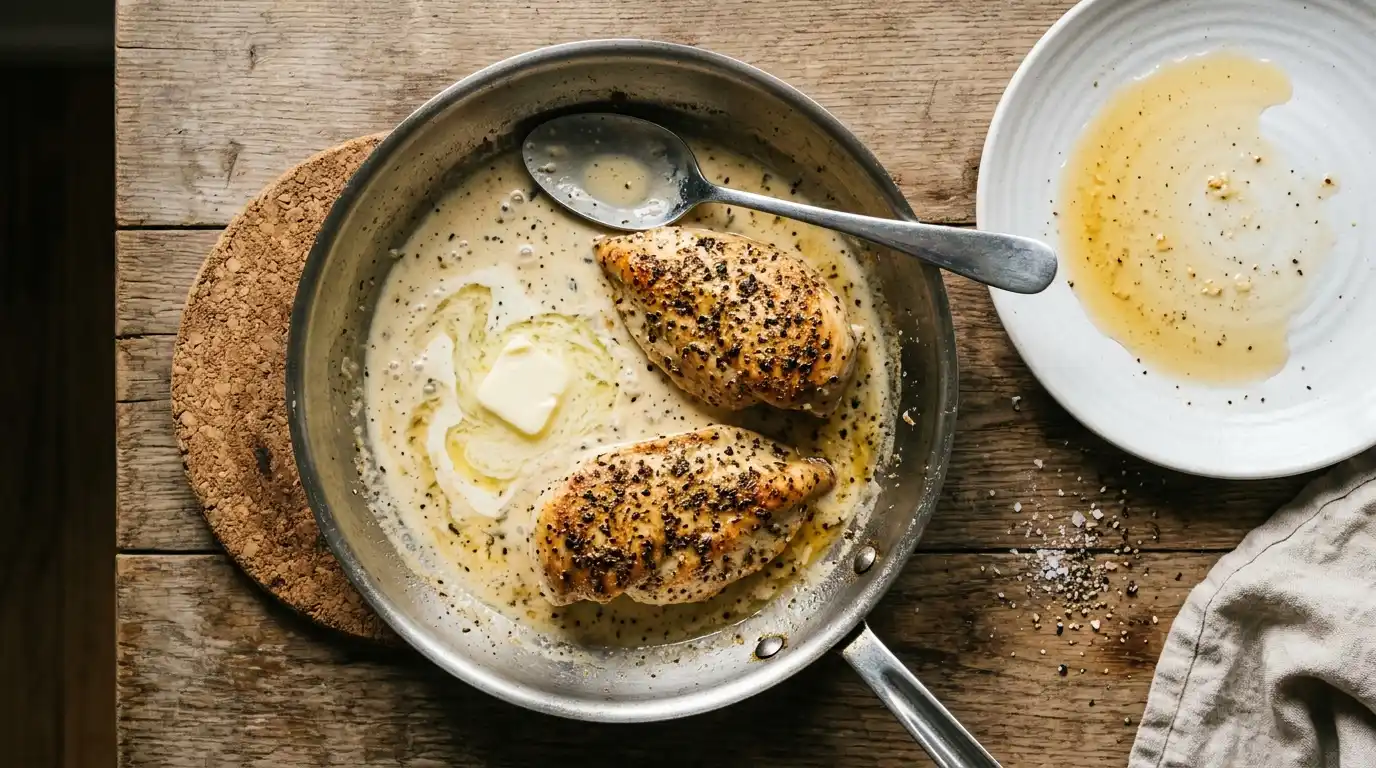
Off the heat it goes. Drop in the last tablespoon of butter straight from the fridge and swirl until it vanishes. Cold butter blends into the sauce and gives it a sheen. Softened butter tends to float on top as an oily film.
Whatever juice has pooled under the resting chicken goes in too. It’s seasoned already and it’s pure chicken flavor.
Return the chicken for about a minute, spooning sauce over it just long enough to warm through. Then plate it and pour the rest of the sauce around the chicken instead of over it, so the crust stays crunchy.
Once the butter’s in, don’t let it boil again or it’ll split.
Hosting? This is the step that buys you time. The sauce holds off the heat for a few minutes while you get plates ready.
10. Green peppercorns for a milder version
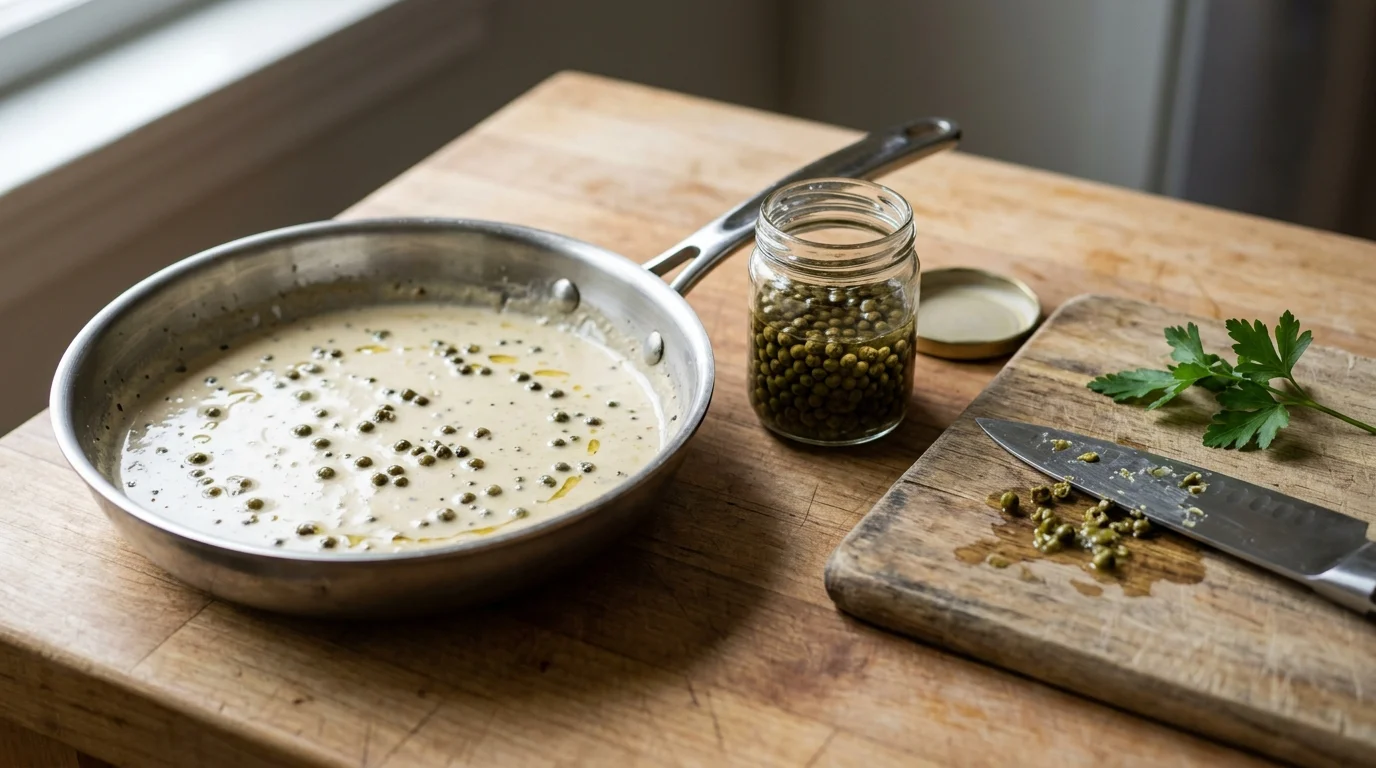
Green peppercorns are ordinary peppercorns picked before they ripen, sold in little jars of brine. Fruitier, much gentler. French cooking even has a version named after them, au poivre vert.
Rinse 1 tablespoon, crush them lightly under the flat side of a knife, and stir them in with the cream and Dijon. Keep the black pepper crust, or switch to a light dusting if you’re going for mild.
They suit anyone who finds the black pepper version too fiery, and they leave the sauce dotted with green.
A jar runs a few dollars. Opened, it keeps for months in the fridge as long as the peppercorns stay under the brine.
11. A whole chicken with the same crust
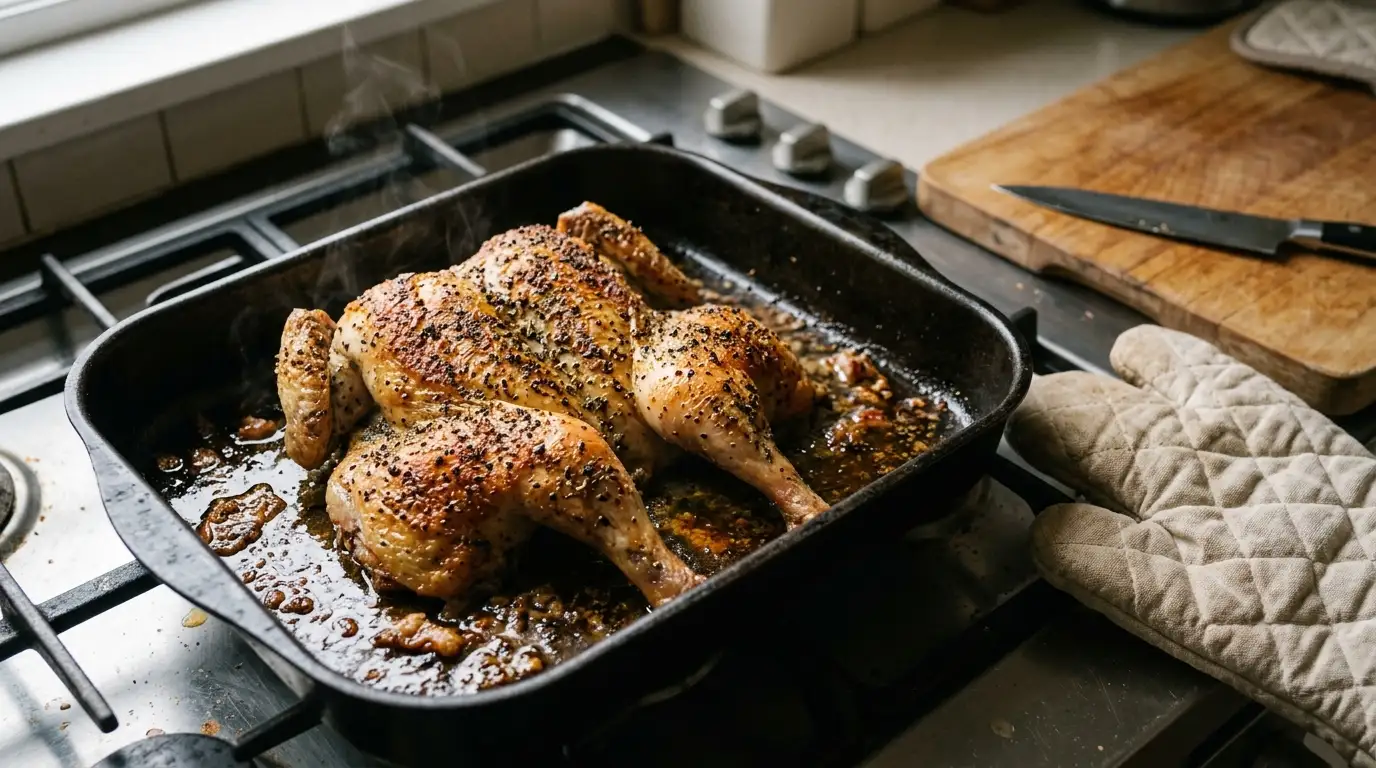
For a chicken au poivre whole chicken version, spatchcock a 4 to 5 pound bird. Snip out the backbone with kitchen shears, turn the bird over, and push hard on the breastbone until it flattens with a crack. Flat birds cook evenly and offer more skin for the pepper to cling to.
Salt it, press cracked pepper over the skin, and roast at 425°F until the thickest part of the breast reads 165°F. Without a thermometer, wiggle a drumstick. Loose in the joint means done.
Build the sauce in a skillet with 2 tablespoons of roasting drippings in place of the oil, then follow the shallot, broth and cream steps.
The downside is time. Between roasting and resting you’re past an hour, and carving next to a pool of cream sauce gets messy. Save it for a Sunday.
Chicken au poivre questions worth answering
What does au poivre mean?
It’s French for “with pepper.” On a menu it nearly always means a cracked peppercorn crust and a pan sauce, usually a creamy one.
Can I make it ahead of time?
Partly. Crush the pepper and pound the chicken up to a day early, keeping the chicken covered in the fridge. Sear it and make the sauce right before dinner, though, since a reheated crust goes soggy. Leftovers keep 3 to 4 days in a sealed container.
Is this the same as the New York Times version?
No. Searches for chicken au poivre ny times, chicken au poivre nyt cooking or chicken au poivre new york times lead to a recipe behind a subscription. This one is written independently, using the standard French pan sauce method.
What sides go best with it?
Mashed potatoes and green beans are the easy pair. Potatoes catch the sauce, beans cut through the cream. Roasted potatoes, buttered rice or a lemony salad work too.
Is this a healthy dinner?
The chicken itself is lean, but the cream and butter carry most of the fat. For a lighter plate, spoon on less sauce and pile on more vegetables.
The one step worth getting right first
If you only fix one thing, fix the peppercorns. Cracking them by hand and sifting out the powder takes a couple of minutes and costs nothing, yet it shapes the flavor of every bite of this chicken au poivre more than any other choice here.
Once that’s second nature, try the green peppercorn version. It’s the quickest way to make the same dinner feel brand new.
This post shares general recipe information and is not nutrition or medical advice.